
Are Silent Gallstones a Time Bomb You’re Ignoring?
Did your doctor tell you that you have silent gallstones, even though you don’t feel any pain?
Are you wondering whether they might suddenly turn into a late-night emergency… or if you should remove the gallbladder early to avoid that risk?
You’re not alone.
Every year, millions of Americans discover gallstones accidentally — usually during routine ultrasound gallstone tests for unrelated issues. And while they may not cause symptoms today, the risk of a sudden gallbladder attack is very real.
So the big question becomes:
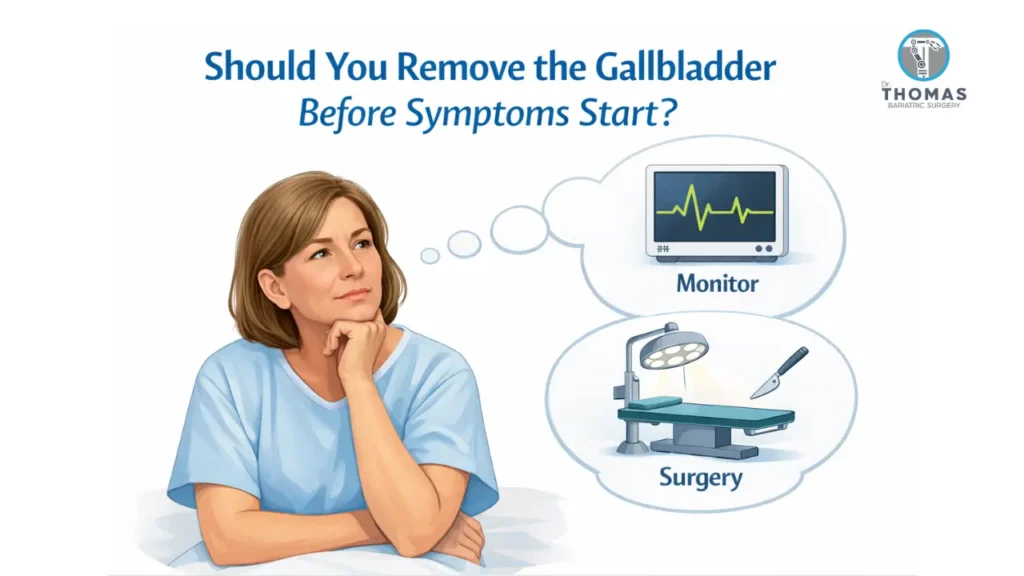
“Should you remove the gallbladder early, even if your gallstones are silent?”
This guide breaks down what research actually says, when asymptomatic gallstones surgery makes sense, and when “watchful waiting” is safe. You’ll also learn when an elective cholecystectomy could prevent dangerous complications later.
And if you want expert help deciding, Thomas Bariatrics is here to guide you with a personalized, surgical-first approach that puts your long-term safety first.
What Are Silent (Asymptomatic) Gallstones?
Gallstones form when bile hardens inside the gallbladder. They can be as small as a grain of sand or as large as a golf ball. But most people never feel them — that’s why they’re called silent gallstones.
Silent gallstones typically:
- Cause no pain
- Cause no digestive issues
- Are discovered accidentally through ultrasound gallstone scans
- Can stay silent for years — or suddenly trigger symptoms without warning
It’s different from mild bloating or indigestion. With silent stones, there are no true biliary symptoms, meaning no pain under the ribs, no nausea after fatty foods, and no biliary colic warning signs.
But silent doesn’t always mean harmless — and that’s where the confusion begins.
Do Silent Gallstones Need Surgery? (What Medical Guidelines Say)
Leading institutions like the Cleveland Clinic, Mayo Clinic, and major surgical journals agree on one point:
Most silent gallstones do NOT require surgery.
Here’s why:
- Only about 1–2% of people with silent gallstones develop symptoms each year.
- Many never develop symptoms at all.
- Surgery has risks, even when minimally invasive.
This is why most doctors recommend watchful waiting unless risk factors are present.
But “most” doesn’t mean everyone. Some patients are more likely to develop gallstone complications, even if their stones are currently silent.
That’s when asymptomatic gallstones surgery (a planned removal) becomes a smart decision.
When Early Removal Makes Sense: High-Risk Categories
Certain patients have a higher chance of their silent gallstones turning into serious problems. For them, early elective cholecystectomy may prevent emergencies later.
You may be a candidate for early removal if you have:
- Large gallstones (>2 cm)
- Calcified (porcelain) gallbladder
- Gallbladder polyps
- A weakened immune system
- Diabetes
- Sickle cell disease
- A family history of severe gallbladder issues
- Frequent travels to remote places where emergency surgery isn’t accessible
These patients face a higher risk of:
- Sudden gallbladder attacks
- Severe infections
- Pancreatitis
- Blocked ducts
- Emergency surgery with higher complication rates
If you fall into any of these categories, removing the gallbladder before symptoms begin can be a smart and preventive step.
At Thomas Bariatrics, our surgeons frequently evaluate high-risk silent gallstones and help patients determine whether early surgery is the safer option.
Potential Risks of Leaving Silent Gallstones Untreated
While most silent gallstones stay quiet, some can change quickly — and sometimes dramatically.
Here’s what might happen if silent stones become active:
- Biliary Colic: Suddenly, sharp pain under the right ribs after eating. These are the classic biliary colic warning signs.
- Acute Cholecystitis: A painful and dangerous inflammation that requires urgent treatment.
- Gallstone Pancreatitis: One of the most serious complications — often requiring hospitalization.
- Blocked Bile Ducts: This leads to jaundice, infection, and severe pain.
- Emergency Surgery: Emergency gallbladder surgery is riskier, more painful, and has a longer recovery time compared to planned surgery.
The bottom line?
Even though silent gallstones may not bother you today, they can still create sudden, severe complications.
What Elective Cholecystectomy Involves (Early, Planned Surgery)
An elective cholecystectomy is a planned, minimally invasive gallbladder removal performed before symptoms start.
Here’s what makes it safer and easier than emergency surgery:
- Small incisions
- Shorter surgery time
- Faster recovery
- Less pain
- Lower risk of complications
- You choose the timing — not an emergency room.
Most patients return to normal activities within a week.
At Thomas Bariatrics, our surgeons use modern minimally invasive techniques to ensure safe, smooth, and predictable outcomes.
Should You Remove the Gallbladder Early? Pros & Cons
Here’s a clean breakdown to help you evaluate your options:
Pros of Early Removal
- Prevents unpredictable gallbladder attacks
- Avoids future gallstone complications
- Safer and easier than emergency surgery
- Offers long-term peace of mind
- Ideal for high-risk patients or frequent travelers
Cons of Early Removal
- Surgery has standard risk.
- You may remove an organ that never would have caused symptoms.ms.
- Cost and downtime
This is why the decision must be personalized — not one-size-fits-all.
Gallstone Prevention: Reducing Future Risks
Even if you choose not to remove your gallbladder now, you can still lower your risk of issues later. Effective gallstone prevention strategies include:
- Maintaining a healthy weight
- Eating high-fiber foods
- Reducing saturated fats
- Staying well-hydrated
- Managing diabetes or metabolic conditions
- Avoiding rapid weight loss
This is also part of long-term gallbladder disease management.
How to Monitor Silent Gallstones (If You Don’t Remove the Gallbladder)
If you decide to “wait and monitor,” here’s the right way to do it:
- Schedule periodic ultrasound gallstone scans
- Understand the biliary colic warning signs
- Seek immediate help if symptoms appear.
- Track any changes in digestion, nausea, or right-sided pain.n
Silent gallstones are not dangerous by default — but ignoring changes can be.
When to Talk to Your Surgeon
You should consult a surgeon if:
- You’re high-risk
- Your stones are larger.ge
- You want to avoid the chance of emergency surgery.
- You’re experiencing even mild symptoms.
- You travel often or live far from the hospital.
At Thomas Bariatrics, we evaluate your risk, your lifestyle, your medical history, and your long-term safety — then help you decide if early surgery is the right move.
Conclusion: Should You Remove Silent Gallstones Before Symptoms Start?
Most people with silent gallstones don’t need immediate surgery.
But for high-risk patients — or anyone who wants to avoid unpredictable emergencies — early removal can be the safest option.
If you’re unsure, don’t guess.
A 20-minute consultation can prevent years of stress or a potential medical emergency.


 Qubopro.com